
A curated collection of SuperMimic implementations, extensions, demos, and resources.
English · 简体中文
Original paper · Official website · Interactive demo · Community projects

World-model predictions
 Simulation |
 Real G1 |
Original footage: SuperMimic authors · Click a preview for the full video · Media credits
Start with the original work below, then choose an implementation by framework and task. This is a community-maintained resource list; the linked implementations are credited to their own authors.
- Original SuperMimic
- Community projects
- Related methods and baselines
- Data and learning resources
- Contributing
- Citation
- Acknowledgements and license
SuperMimic: Scaling Humanoid Whole-Body Control with One Differentiable World Model
Qiayuan Liao, Yiyang Shao, Junfeng Long, Kevin Zakka, Roberto Horowitz, Pieter Abbeel, and Koushil Sreenath.
UC Berkeley · CoRL 2026 Oral
Paper · PDF · Project · Video · Browser demo
SuperMimic learns shared humanoid dynamics from simulator transitions and improves a motion-tracking policy through short imagined rollouts. The world model and policy are updated in the same training loop; policy gradients pass through the learned model. Method overview.

Original paper, Figure 2 · Framework, p. 4 · Algorithm A.1, p. 15
The world model is fit on 8-step replay windows; the policy and critic learn from 32-step imagined rollouts. During the policy update, model weights stay fixed while gradients pass through the model to the policy. Blue dashed arrows show gradients; ❄️ marks frozen weights and 🔥 marks weights being trained in that phase.
The authors report surpassing SONIC's released-checkpoint return after 3 hours on one H100, with 25 / 129,514 failed motions, and 0 / 129,514 after 9.8 hours on two H100s. These are training-motion coverage results, with different training hardware and data from SONIC. See the official results and compute accounting.
Official code status — checked 2026-10-26: the official website links the paper, video, and browser demo, but does not link a training-code repository. The projects below are community implementations and extensions.
29 community projects, grouped by purpose. Descriptions were checked against upstream documentation and selected source files on 2026-10-26; each entry links to the reviewed source revision. Results and demos are upstream reports; this list has not independently rerun the experiments.
- 🔬 Independent reproductions — 3 projects · Reproduce and evaluate the original method.
- 🧩 Methods and task extensions — 11 projects · Explore new methods, tasks and control settings.
- 🛠️ Frameworks, robot ports and deployment — 12 projects · Find a stack, robot port or deployment path.
- 💡 Inspired experiments — 3 projects · Transfer ideas to other control problems.
Reimplementations of the original method, with training, evaluation and reproduction notes.
Repository · Setup and usage · Results
- By Chong Zhang. An independent G1 implementation on Isaac Lab 3, with a kit-less setup, training, full-clip evaluation and rendering tools.
- Upstream report: On 40 LAFAN1 clips, normalized return 0.829 and 0 / 40 failures after 1.47 hours on one RTX PRO 6000 Blackwell.
- Useful context: The author describes it as a rapid, unreviewed reproduction. Documented deviations include disabled self-collisions, bf16 MLP computation and an extra reference-root orientation input. Source snapshot.
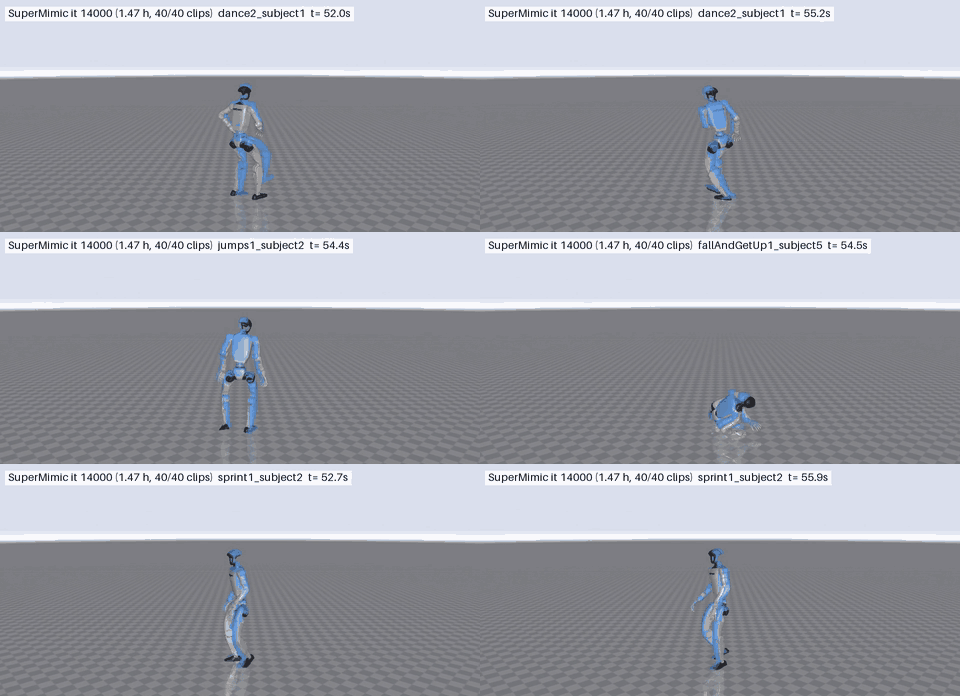
Simulation · LAFAN1 highlights
Repository · Setup · Experiment log
- By CuboiLeo. A from-scratch mjlab implementation for G1, with Chinese reproduction notes, LAFAN1/BONES-SEED processing, multi-GPU training and an interactive replay viewer.
- Upstream report: With anchor-relative observations, one RTX 5090 reaches LAFAN1 return 0.824, 5 / 40 failures at 1.66 hours, and 0.904, 3 / 40 failures at 3.3 hours.
- Useful context: The paper-observation run reports 0.56 and 9 / 40 failures at 1.8 hours. These observation settings are not equivalent; the reported BONES-SEED scores use a 2,000-motion evaluation subset. Source snapshot.

Report screenshot · paper-style and anchor-relative observations
Repository · Setup · Results log
- By dhmbb2. An independent G1 reproduction in mjlab, covering PPO-Sim/PPO-WM comparisons, horizon and critic ablations, push recovery and velocity-control experiments.
- Upstream report: On one RTX A6000, LAFAN1 normalized return reaches 0.833 at 1.34 hours and 0.946 with 0 / 40 failures at 12 hours, using complete deterministic clip evaluation.
- Useful context: The experiment log distinguishes reproduced, partial and pending results. BONES-SEED remains data-gated, hardware transfer is out of scope, and the A6000 timings are not H100 timings. Source snapshot.

Report screenshot · reproduction and ablations on one RTX A6000
Changes to the method, new tasks and focused experiments in perception, morphology and interaction.
Repository · Setup · Method differences
- By Lizhi Yang et al. Extends SuperMimic in mjlab to share a world model, a policy, or both across G1, X2 Ultra and T2, conditioning the networks on robot morphology.
- What it provides: Supports full-motion tracking and sparse five-point goals for the pelvis, wrists and ankles; the project includes a browser demo and teleoperation/deployment instructions.
- Useful context: Robots are mapped to a common 29-joint layout. The README documents changes to termination modeling, normalization, warm-up and actuator-delay randomization. Source snapshot.

Simulation · one shared policy for G1 / X2 Ultra / T2
Repository · Install · Results
- By Shimingyi. Builds on supermimic_vibe for G1 in mjlab, mixing residual upper-body actions with absolute leg actions, weighting world-model losses and balancing motion sampling.
- Upstream report: With the recommended preset on one RTX 4090, full-length LAFAN1 evaluation reports 0 / 40 failures and return 0.91 after 0.83 hours; training time excludes evaluation.
- Useful context: The recommended preset changes the method and data sampling. The 306-hard-motion-only run and full BONES-SEED training are separate experiments. Source snapshot.
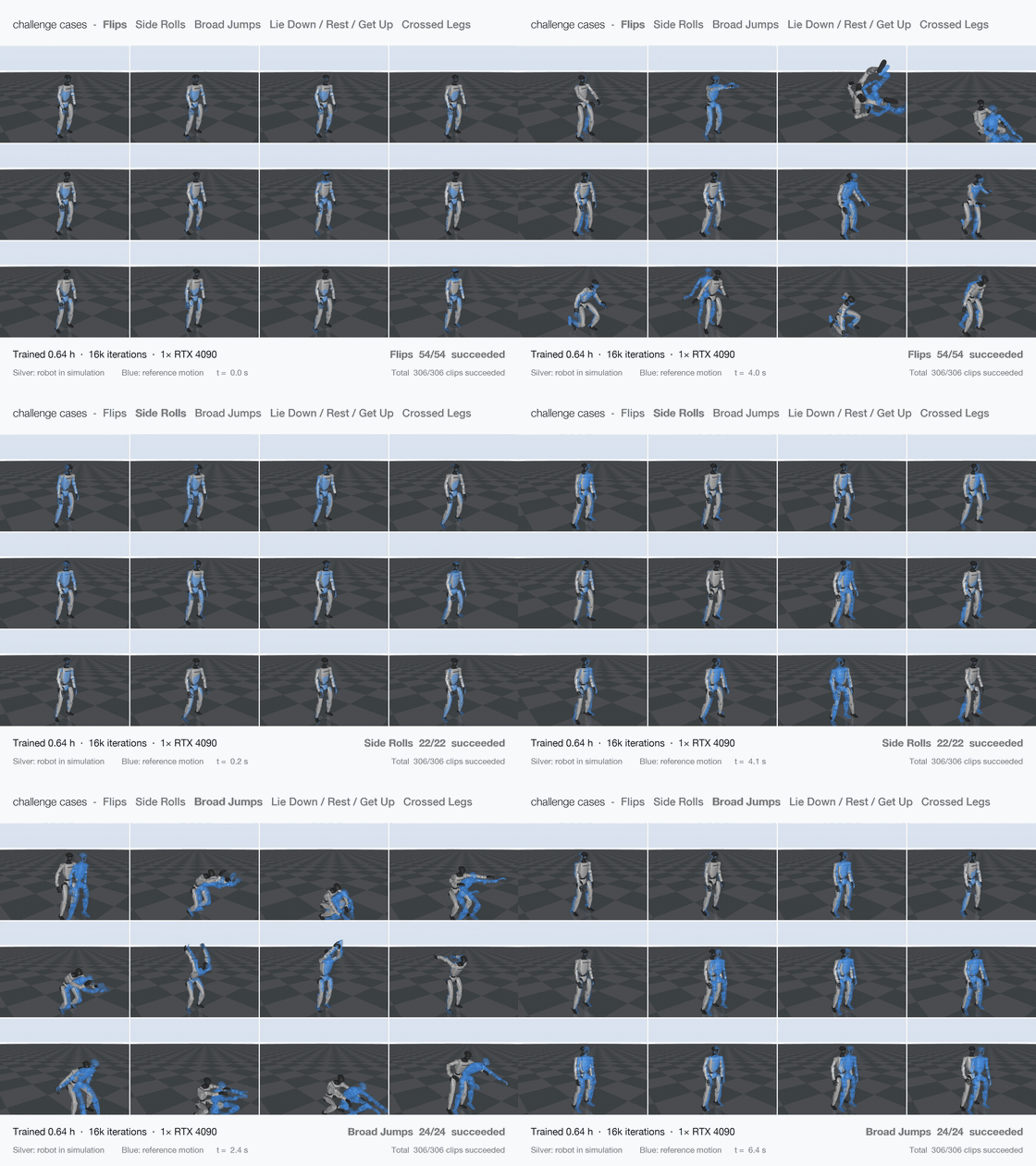
Simulation · challenging motion clips
Repository · Setup · Results
- By Alchedata. Ports the method to H1 with JAX and LocoMuJoCo, comparing an MLP baseline with residual-expert, action-sensitivity and trust-aware world models.
- Upstream report: Publishes fixed 5,000-iteration checkpoints evaluated over 160 episodes, including both successful seeds and a residual-expert run that became stuck with saturated actions.
- Useful context: The reward is LocoMuJoCo episode return, not the G1 normalized tracking score. Recovery interventions and their continuation controls are recorded separately. Source snapshot.

Report screenshot · fixed 5k checkpoints, 160 evaluation episodes
Repository · Installation · Implementation comparison
- By btx0424. Studies goal conditioning for G1 in mjlab: concatenating the goal with proprioception versus using FiLM to modulate the policy layers.
- Useful context: Provides configurable observations, anchor choices and Viser playback. Its implementation table explains differences from the paper and supermimic_vibed, including self-collisions and observation inputs. Source snapshot.

Implementation table excerpt · first three design choices; click for the full comparison
Repository · Method and results · Releases
- By Project Instinct. Extends the method to perceptive G1 tracking and goal-reaching parkour in mjlab / instinct_rl. The world model predicts robot state and depth-encoder latents; components are adapted from supermimic_vibed.
- Upstream report: 97% full-motion success across 10 motions on 5 terrains after 8,000 iterations / 3.2 hours on one RTX 3090; one seed, 12–13 episodes per motion, camera noise enabled.
- Useful context: Use the supermimic branch. This is terrain tracking, distinct from flat-ground LAFAN1; external checkpoints require joint-order adaptation. Licensed CC BY-NC 4.0. Source snapshot.

Method diagram · robot-state and visual-latent prediction
Repository · Method · Progress
- By mode1223345. Builds on supermimic_vibed in Isaac Lab 3, pretraining a heightmap autoencoder and freezing one shared encoder for the actor, critic and world model.
- What it provides: Documents four flat-ground/step-terrain control experiments and separate reconstruction checks; the published control comparisons remain in progress.
- Useful context: Maps come from simulator ground truth. Real-depth reconstruction and hardware perception are not integrated, and inherited baseline scores do not establish gains from the encoder. Source snapshot.

Training curves · 2026-10-24 snapshot; control comparisons in progress
Repository · Quickstart · Pretrained policies
- By Zhengtianjin. Adapts SuperMimic to Unitree Go2 chase-and-dodge tasks in mjlab, covering flat ground, obstacles and terrain with LiDAR or height-scan inputs.
- What it provides: Publishes separate flat, obstacle and terrain actors, plus evaluation and recording tools. Actor-only downloads support playback; resuming training also needs the world model and critic.
- Useful context: Simulation only, with ground-truth target perception. The released terrain policy still has falls and bar collisions under the hardest settings. Source snapshot.
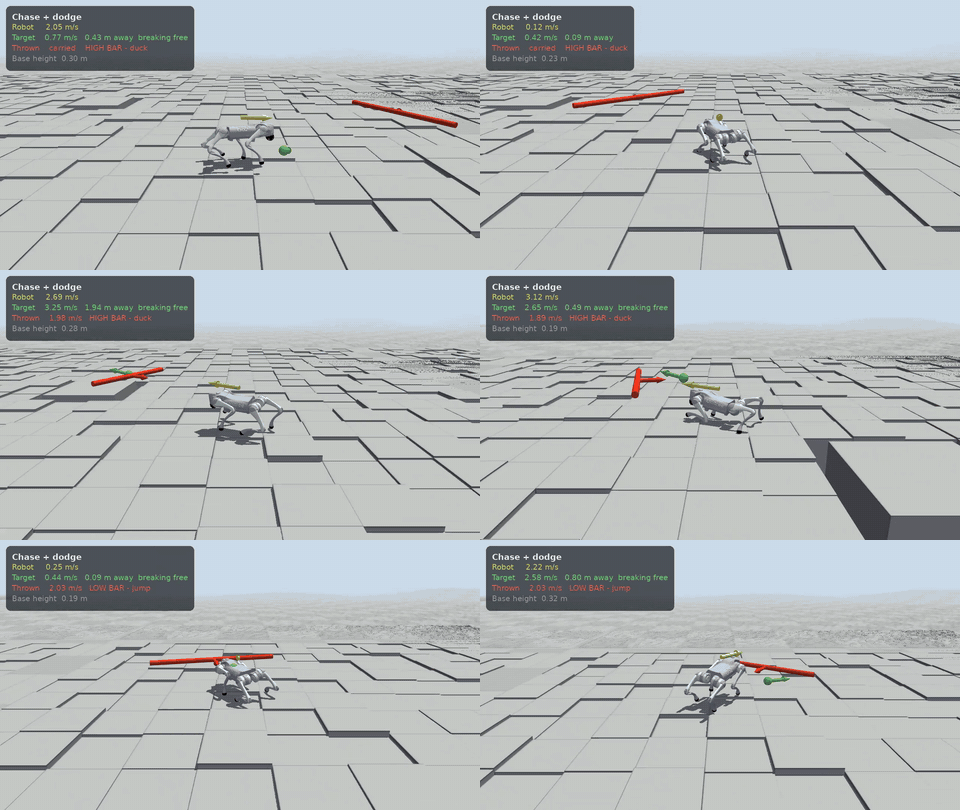
Simulation · Go2 terrain chase and dodge
Repository · Installation · Checkpoint
- By CumulusAlpha. Adapts world-model-based policy training to in-hand cube reorientation with Wuji Hand 2, using mjlab / MuJoCo Warp and the InstinctMJ task framework.
- What it provides: Provides the model_8000.pt checkpoint and a Viser viewer. Hand assets are bundled with the package; the pretrained checkpoint is downloaded separately from Releases.
- Useful context: This is a dexterous-manipulation adaptation with a different task and reward from humanoid motion tracking. Source snapshot.

Simulation screenshot · Wuji Hand 2 cube reorientation
Repository · Quickstart · Results and protocol
- By shuayyy. Compares SuperMimic and PPO-Sim on shared G1 walking, squatting and box-lifting tasks in mjlab; the repository also contains a separate AMP-PPO stack.
- Upstream report: Box-lift success reaches 100% at 31 million environment steps, reported for two SuperMimic seeds with 64 randomized evaluation episodes; success means finishing within 10 cm of the reference box height.
- Useful context: Those SuperMimic scores used clean observations. The newer evaluation adds observation noise, and the published checkpoints have not been re-evaluated under that setting. Source snapshot.
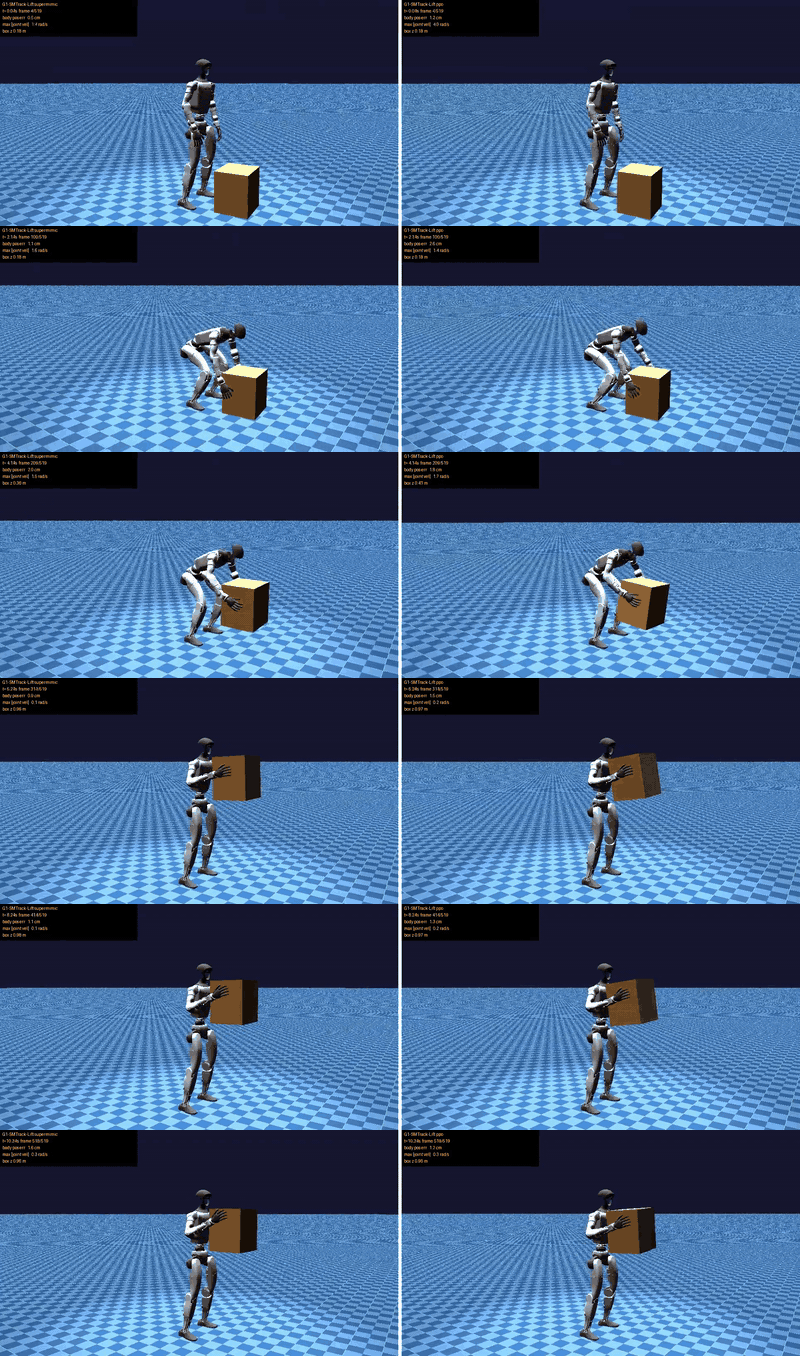
Box lift · SuperMimic 12k / PPO-Sim 6k iterations
Repository · Current status · Skateboarding report
- By shangchaohu718. Builds on UniSuperMimic for G1 interaction experiments, retaining a frozen tracker while developing separate interaction policies in UniLab / MuJoCo.
- Upstream report: A separate skateboarding policy completes 30-second simulated runs from one standard and eight held-out perturbed initial states, traveling 39.87–42.13 m.
- Useful context: Tracking and skateboarding are selected as separate branches. A shared world-model-driven interaction actor is not established; box handling and stairs remain unsuccessful in the reported prototype. Source snapshot.

Report screenshot · tracking checkpoints 500–6000; separate from skateboarding
Repository · Results · Quickstart
- By liudi159. A focused G1 backflip study on Isaac Lab 3 and one RTX 5090, tracking leg symmetry, contact forces, penetration and landing stability.
- Upstream report: The final V14 checkpoint completes the rotation and landing hold, but the original strict evaluation records one frame of non-foot penetration and fails acceptance.
- Useful context: An independent rerun changes the borderline contact outcome. Both records are retained, so the clip should not be read as robust success or reproduction of all paper experiments. Source snapshot.

Simulation · final V14 policy; strict evaluation failed
Choose a simulator or robot platform, then find training, retargeting, export and deployment tools.
Repository · Training guide · Results
- By Horizon Robotics. Integrates SuperMimic into HoloMotion’s G1 assets, HDF5 motion data and Hydra workflow, sharing tasks and evaluation with PPO on MuJoCo Warp and Isaac PhysX.
- Upstream report: The selected MuJoCo Warp recipe completes 32 / 40 LAFAN1 training clips after 30 minutes on one RTX 5090.
- Useful context: The validated route uses a compact policy. The preview shows short excerpts from a separate run; it does not replace complete-clip evaluation or establish the planned large-policy integration. Source snapshot.
Simulation · PPO / SuperMimic, two backends
Repository · Install · Results and limits
- By Renforce Dynamics. Provides a shared Isaac Lab / PhysX workflow for retargeting, training, full-clip evaluation and export across G1, Go2, A3, T1, Bumi and Pi+, plus Go2 task policies.
- Upstream report: Re-evaluation of the 32,000-iteration G1 parent checkpoint reports normalized return 0.8694663 and 0 / 40 LAFAN1 failures.
- Useful context: Results use PhysX, while supermimic_vibed uses MuJoCo Warp. Robot-specific motion libraries and training histories differ; held-out motion generalization remains unmeasured. Source snapshot.
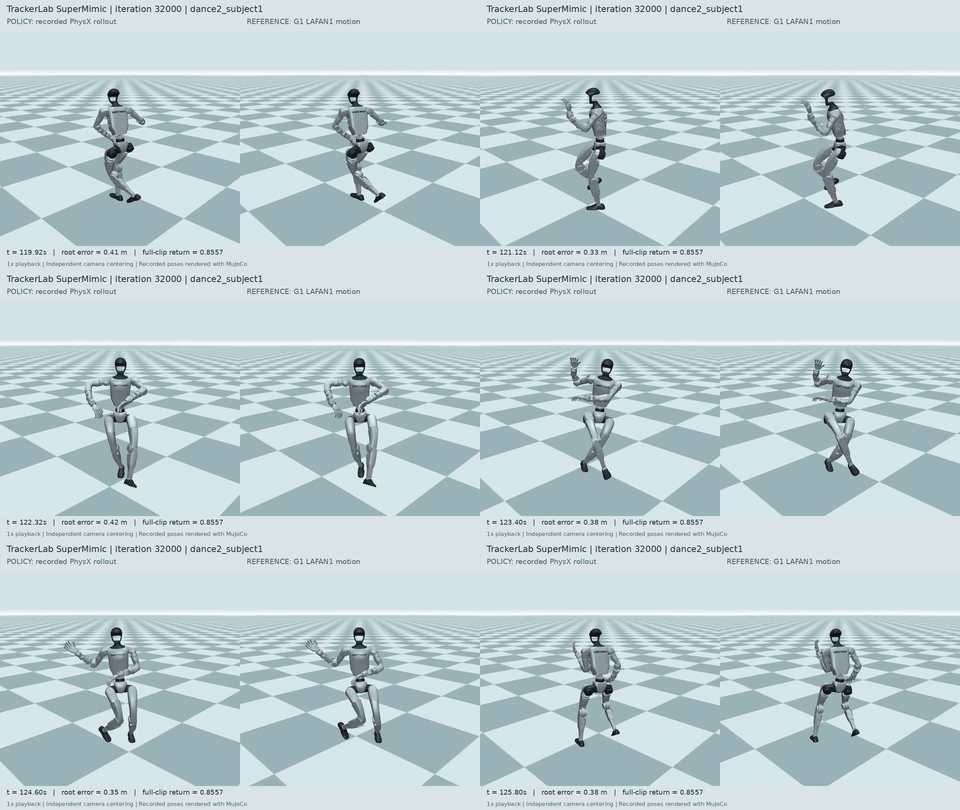
Simulation · G1 policy / reference dance
Repository · Installation · Results
- By Motphys. Ports supermimic_vibed to a UniLab Manager-Based G1 task, with asset preparation, selectable simulation backends, deterministic full-clip evaluation and video export.
- Upstream report: At iteration 12,000, macro normalized return is 0.827227 with 0 / 40 LAFAN1/G1 failures, using UniLab 1.5.0, mjwarp and 4,096 training environments.
- Useful context: The published tracking result uses mjwarp. MuJoCo and Motrix entry points do not establish equivalent training results. Source snapshot.
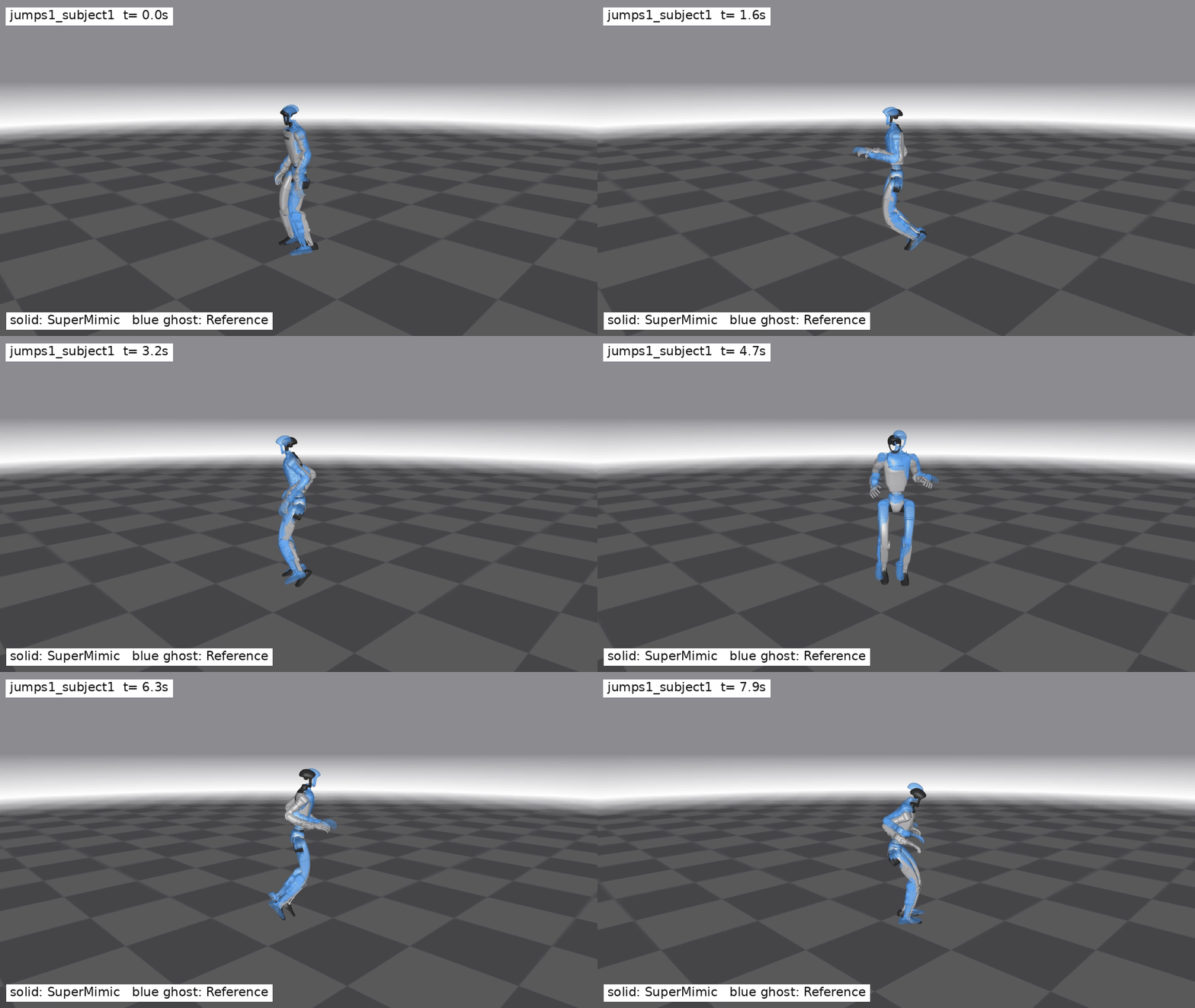
Simulation · G1 jump tracking
Repository · Setup · Custom-task guide
- By chu-fa. Packages a reusable SuperMimic learner and runner for Isaac Lab custom tasks, with a separately installable AGIBOT A3 example.
- What it provides: Provides task contracts, setup instructions and backend validation records. A custom task must supply differentiable state, observation, reward and termination functions.
- Useful context: Targets the Isaac Lab 3 development API. The A3 preview uses separately initialized segments; convergence, backend equivalence and hardware deployment are not established. Source snapshot.
A3 reference / policy · separately initialized segments
Repository · Preview release · Evaluation and limits
- By OMEGA-i. An independent MuJoCo Warp implementation for G1, H2 and A3, with motion retargeting, policy/world-model ONNX export and WebGPU browser previews.
- Upstream report: Publishes separate train40 and held-out val37 evaluations for G1/H2. The G1 55.5k preview reports 0.7990, 3 / 40 failures on train40 and 0.3103, 31 / 37 failures on val37; A3 100k full-clip evaluation is pending.
- Useful context: An experimental preview with limited held-out tracking and documented later-checkpoint regressions. Supply licensed motion data; no top-level code license was found at the reviewed revision. Source snapshot.
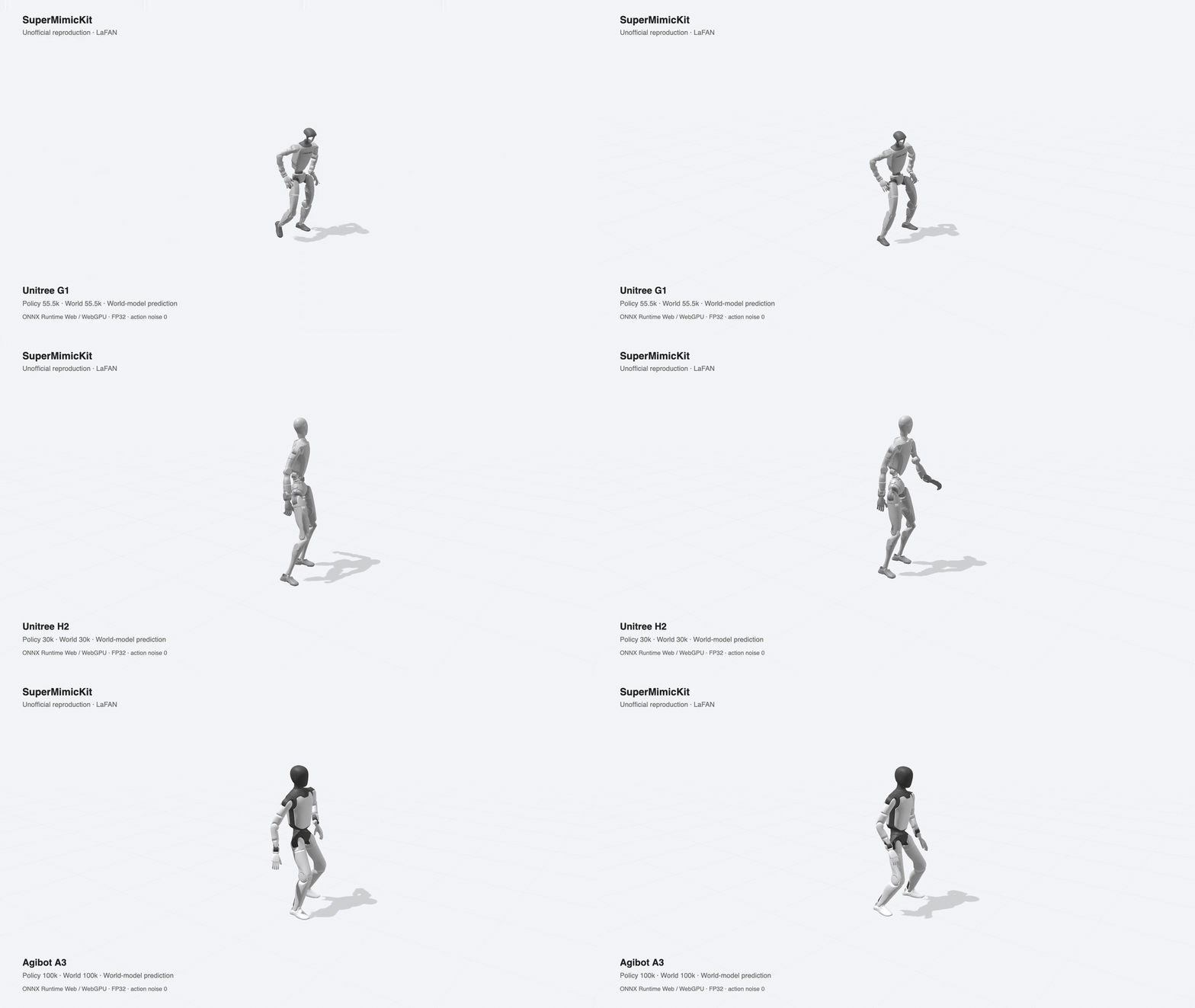
Browser preview · G1 / H2 / A3
Repository · Quickstart · Data guide
- By tianshuwu. Extends the CuboiLeo mjlab baseline to G1, A3 and X2 Ultra, adding robot-specific kinematics, SOMA retargeting, coordinate corrections and foot-contact checks.
- What it provides: Publishes LAFAN1/BONES-SEED preparation workflows and historical evaluation records. Training weights are not distributed, and motion data must be prepared separately.
- Useful context: The reported policies use extra anchor-relative observations computed from simulator truth. These require corresponding state estimation on hardware; real-robot transfer is not validated. Source snapshot.
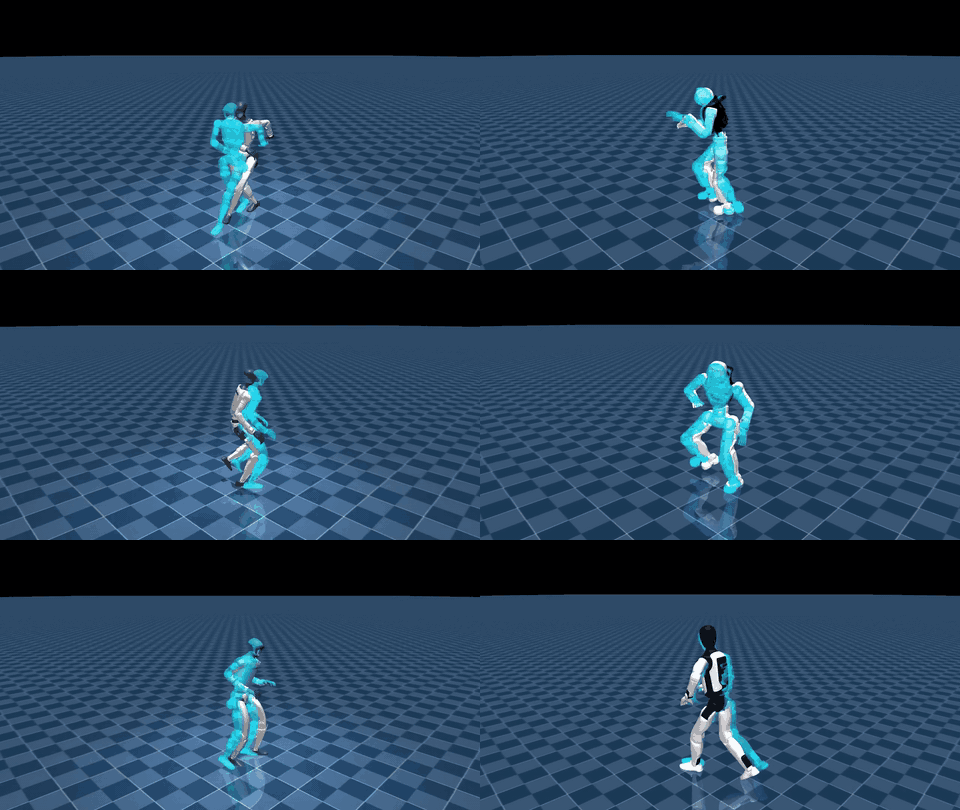
Simulation · G1 / X2 Ultra / A3
Repository · Setup · Results
- By wenconggan. Adapts the Isaac Lab 3 implementation to the 21-DoF DroidUp E1, with standalone native-MuJoCo sim-to-sim playback and evaluation.
- Upstream report: The 164k checkpoint completes 40 / 40 training motions, return 0.8559, in Isaac Lab. A separate 168k checkpoint completes 10 / 10 sampled eight-second segments in native MuJoCo.
- Useful context: Complete-clip evaluation and independently initialized short segments use different protocols. Neither result measures unseen-motion generalization or hardware transfer. Source snapshot.
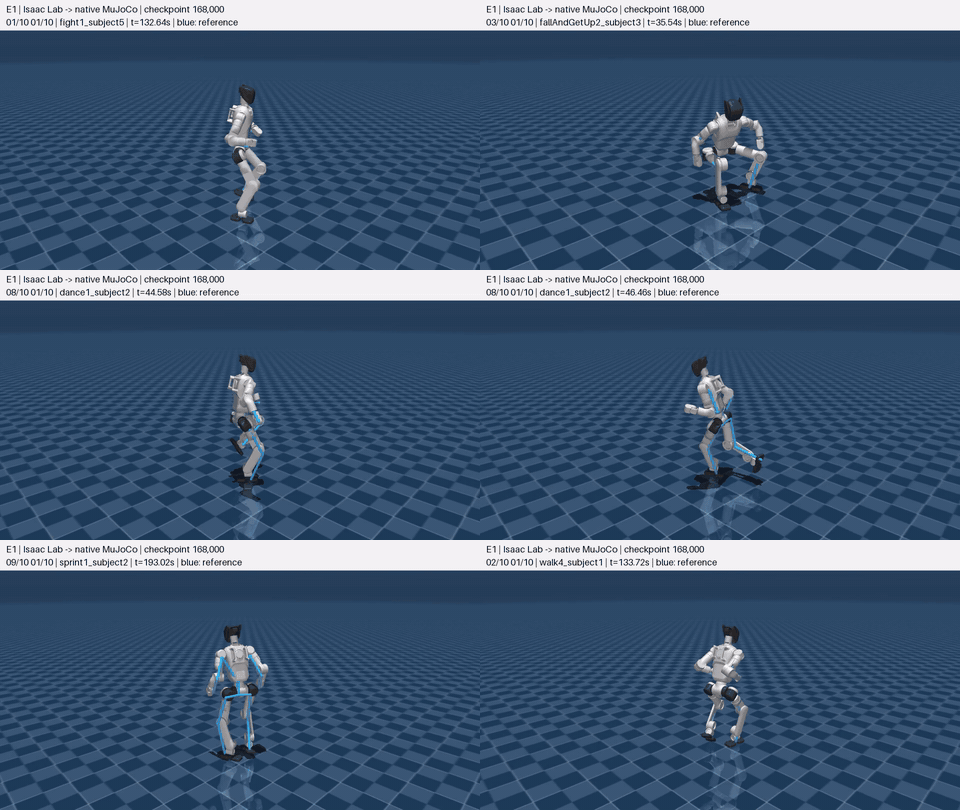
E1 sim-to-sim · native MuJoCo
Repository · Setup · Results
- By liuskywalkerjskd. Ports supermimic_vibed to the 31-DoF LimX Oli in Isaac Lab 3, adding motion retargeting, robot kinematics and full-motion video export.
- Upstream report: At iteration 18,000, the original 40-motion LAFAN1 evaluation reports return 0.6783 and 36 / 40 completed clips, after about 2.20 hours on one RTX 4090.
- Useful context: The displayed walking clip is a selected excerpt. Use the full-library evaluation when judging tracking coverage. Source snapshot.
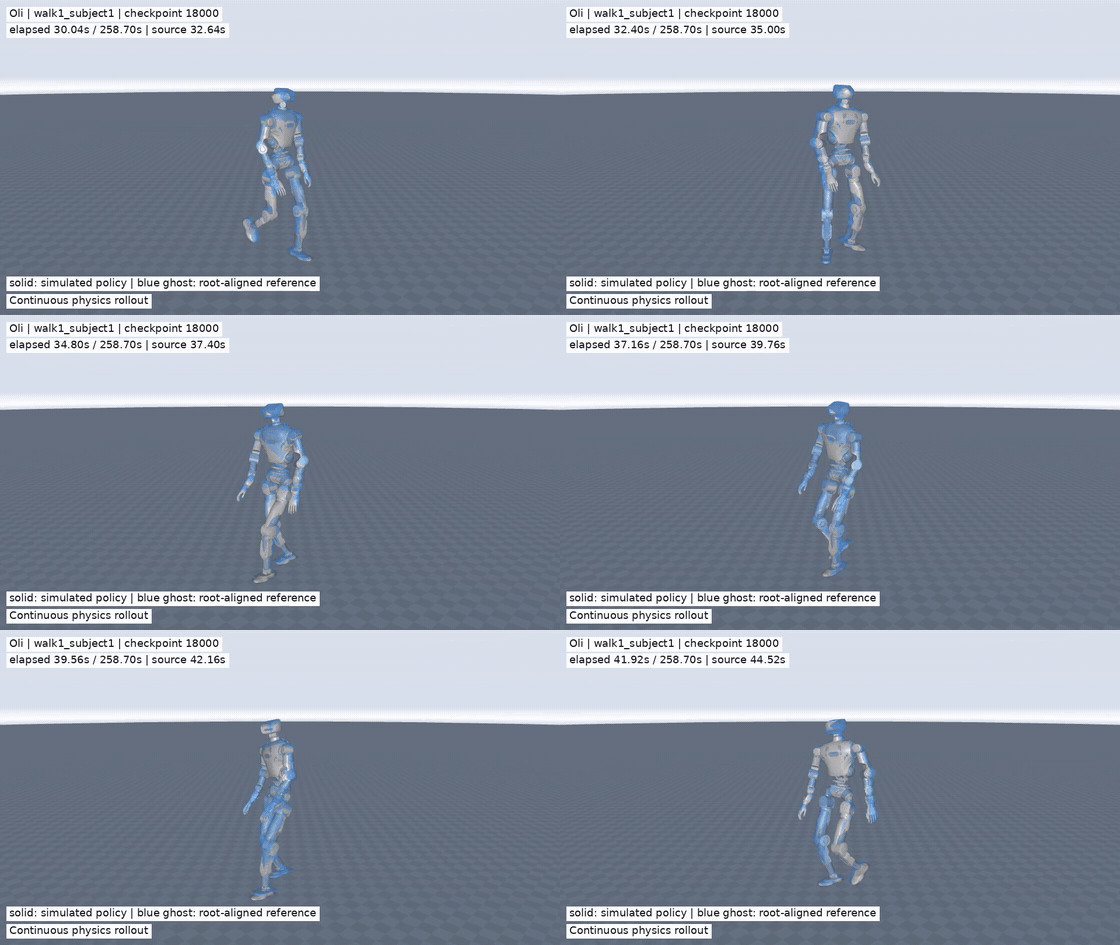
Simulation · selected Oli walking excerpt
Repository · Run the released model · Results
- By WXyuany. Adapts the CuboiLeo G1 baseline to Apple Silicon, using CPU MuJoCo for physics and PyTorch MPS for learning, with released weights and playback tools.
- Upstream report: For the released 21k checkpoint on a 24 GB Apple M5, seed 0, the original 40-motion evaluation reports return 0.7081 and 25 / 40 completed clips; a fresh-environment check completes 26 / 40.
- Useful context: Return is normalized by executed steps without zero-padding after failure, and the actor uses nine extra anchor-observation dimensions. Read return together with completion; held-out generalization is untested. Source snapshot.
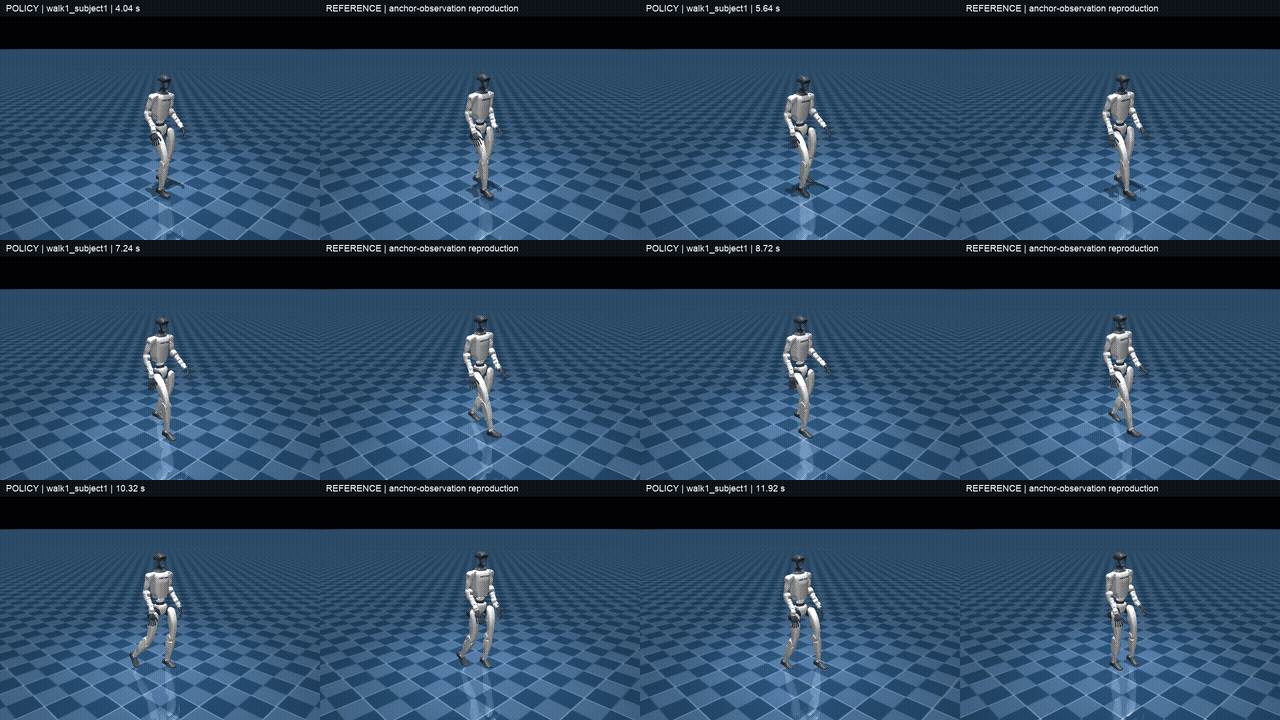
Simulation · G1 walking on Apple M5
Repository · Setup · Evaluation
- By panhainan2020. A standalone mjlab / CPU MuJoCo port of supermimic_vibed for G1, with observation-compatibility profiles, inference weights and held-out 100STYLE evaluation.
- Upstream report: The fixed 98k policy completes 40 / 40 LAFAN training motions at return 0.8713, and 3,569 / 3,573 unseen 100STYLE clips at 0.8045, without fine-tuning.
- Useful context: The datasets differ in duration and retargeting. “Completed” means no termination was triggered; this does not reproduce the paper’s full training schedule or all experiments. Source snapshot.

Report screenshot · LAFAN training motions and unseen 100STYLE clips
Repository · Quickstart · G1 deployment
- By NJU R&L Group Embodied Lab. Extends the CuboiLeo mjlab baseline with custom dance/video-motion tools, ONNX export and G1 deployment through native MuJoCo and the Unitree SDK.
- Upstream report: Publishes a roughly 46-second real-G1 dance combining four motion segments, alongside pretrained models and the original video.
- Useful context: The README separates paper-style observations from anchor-augmented training. The latter requires global-relative information unavailable in the demonstrated hardware setup. Source snapshot.
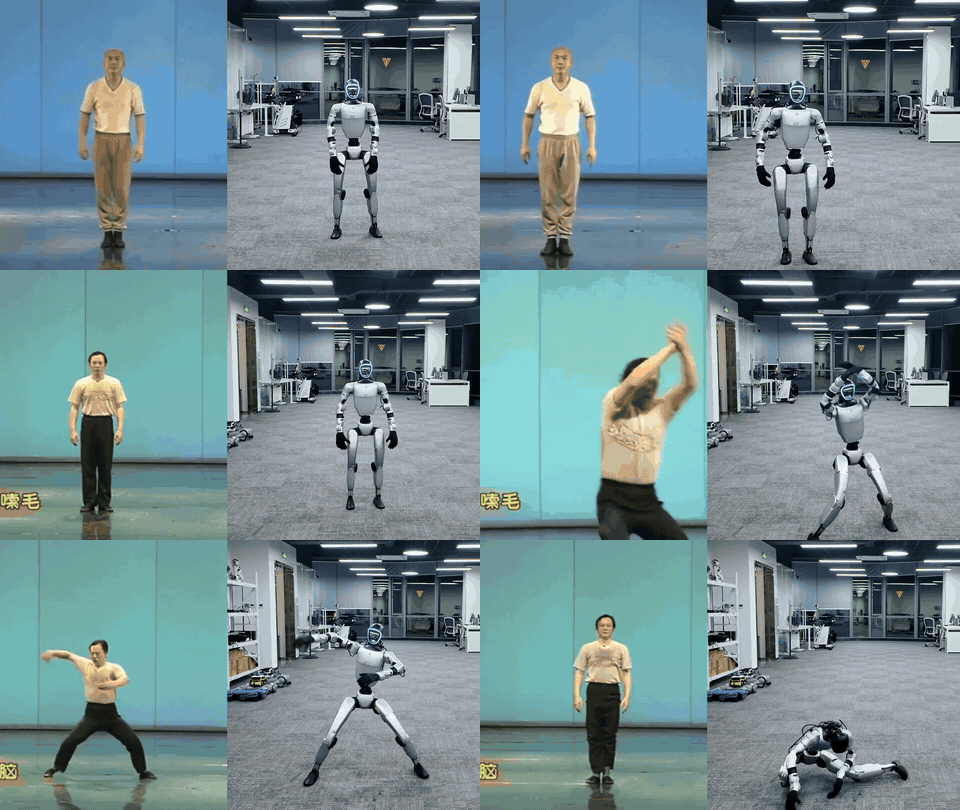
Real G1 · dance with human reference
Repository · MuJoCo guide · Real-G1 guide
- By KyrieYoung926. A deployment runtime for a SuperMimic-Reproduced policy on the 29-DoF G1, using ONNX Runtime, MuJoCo and Unitree SDK2.
- What it provides: Provides both simulation and real-G1 demos, with separate guides for fetching deployment assets and running the policy on each target.
- Useful context: This repository covers deployment, not a new training benchmark. Motion data, model weights and robot assets retain their own terms beyond the code license. Source snapshot.
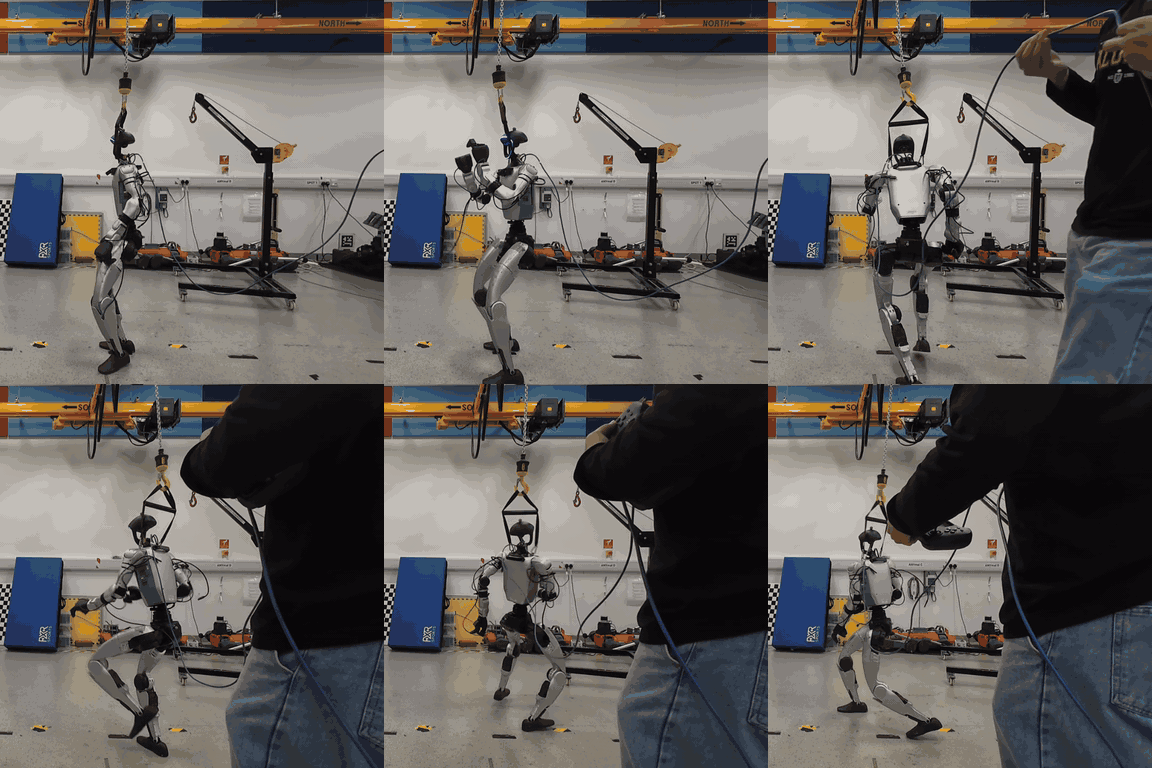
Real G1 · upstream deployment demo
Ideas transferred to other control settings, with different tasks and evaluation protocols.
- By hitsz-oyx. Explores action-conditioned contact dynamics and short-horizon BPTT for the Inspire hand in Isaac Gym / DExplore, combining contact memory with native collision-geometry queries.
- What it provides: Separately records behavior cloning, dynamics fitting, bounded actor/critic updates and native-physics evaluation.
- Useful context: Improved reference survival comes with lower mean return in the reported comparison. Reliable model-based manipulation gains are not established, and contact proxies are not certified grasp success. Source snapshot.

Report screenshot · native-physics comparison; higher reference survival, lower mean return
- By azizkhadraoui. Transfers SuperMimic-style gradient-based learning to G0.5 VLA steering on LIBERO: a noise policy is trained through a frozen flow sampler using world-model and critic gradients.
- Useful context: This is one task-specific steering experiment within a broader VLA stack. The linked script identifies the relevant method; the repository’s other planning and memory results are separate experiments. Source snapshot.

Code index screenshot · world-model / critic steering experiment
Repository · Quickstart · Reference motions
- By swaggyliu. Recreates the shared-world-model and imagined-policy-learning loop in FlatWorld with an eight-joint 2D humanoid and motion-tracking tasks.
- What it provides: Provides training, reference baking, per-skill rendering and a multi-skill showcase for walking, running, jumping, dancing and other motions.
- Useful context: References are procedural, LAFAN-like 2D motions, not the LAFAN1 dataset. The character also uses a mild root assist, so this is an illustrative adaptation rather than a G1 benchmark. Source snapshot.

2D simulation · motion-tracking showcase
These works provide methodological background or comparison points; they are separate research projects.
| Work | Connection | Primary resources |
|---|---|---|
| SuperTrack (2021) | Earlier character motion tracking through a learned differentiable world model and gradient-based control learning. | Author explanation · Paper |
| BeyondMimic (2025) | Humanoid motion tracking and guided diffusion control; supermimic_vibed references its actuator and task conventions. |
Project · Paper |
| SONIC (2025) | Large-scale humanoid motion tracking; the original SuperMimic work compares against a released SONIC checkpoint. | Project · Paper · Code |
- LAFAN1 retargeting dataset — G1 motion assets used by
supermimic_vibed, UniSuperMimic, and SuperMimic-Reproduced. Follow each repository's preparation instructions and the dataset's own terms. - BONES-SEED — the motion-data source used for the original paper's large-scale benchmark. The raw dataset and paper-filtered evaluation set have different counts. Access requires accepting the dataset's terms on Hugging Face.
- Official interactive demo — explore the original policy in the browser before choosing a training stack.
- Official method explanation — simulator collection, model fitting, and policy learning.
- InstinctMJ releases — upstream distribution of task data and model assets; check the release description for the relevant branch and task.
Have a new implementation, extension, tutorial, or demo? Open a pull request using the contribution guide. Include the original source, the relationship to SuperMimic, the relevant branch, and evidence for any result you quote.
When building on the method, cite the original SuperMimic paper and credit the implementation you use. BibTeX below follows the official project:
@inproceedings{liao2026supermimic,
  title     = {{SuperMimic}: Scaling Humanoid Whole-Body Control
               with One Differentiable World Model},
  author    = {Liao, Qiayuan and Shao, Yiyang and Long, Junfeng and
               Zakka, Kevin and Horowitz, Roberto and Abbeel, Pieter and
               Sreenath, Koushil},
  booktitle = {Conference on Robot Learning (CoRL)},
  year      = {2026}
}Thanks to the original SuperMimic authors and all community maintainers. The presentation of this list is inspired by Awesome Nano Banana Images and Awesome World Models.
The original curation text in this collection is released under CC0 1.0. Third-party code, papers, datasets, and media retain their respective rights and terms. This includes the original paper figure and official video previews stored in this repository; they are not covered by this collection's CC0 dedication. Community media previews and credits follow the same attribution rule.